Volunteering in Armenia-- A reflection
 Sima Cunningham
What makes someone want to volunteer? This was a question I asked myself a lot during my time in Armenia. Not so much because I had just taken four months off of school to come to Armenia to volunteer, but more because I spent a good deal of my time there trying to encourage others that volunteering is a desirable thing to occupy your time with.
When I first arrived in Armenia I was told I was going to be volunteering at two locations: Manana Youth Education Center and Naregatsi Art Institute. I didn’t know much about what I would be doing beyond teaching an English class to an unknown number of students of an unknown age. The first couple of weeks, I honestly felt like I didn’t know what I was doing there. Here I was, a 20-year-old student who has never taught a formal class before, never written an official grant proposal and certainly never learned how to understand a budget. I’d volunteered a lot during my life: built houses, done food drives, flower-pot fundraisers and more, but I’d always had a pretty firm idea of what I was doing, and more often than not, someone to tell me exactly what to do.
This kind of volunteering was different. I soon realized that I was going to have full control over the creation of an hour long English class twice a week with anywhere between 8-20 kids from ages 9-16 with English abilities ranging from “hello” to Jane Eyre. I learned quickly that the grants that I was applying for were serious and heavily depended on my ability to complete them correctly. More than anything, I learned that when working in a new place, you have to be flexible and sometimes spend a lot of time listening and trying to understand before trying to change anything.
This kind of volunteering is not the kind of hammer-and-nail, soup-and-bread kind of volunteering that I was used to. It required a serious commitment of my mind and my energy. When I first realized this, I really intimidated me and I kept wishing that someone would just give me a manual and tell me exactly what to do with my students and how to best help my co-workers. These anxieties would come and go throughout my time in Armenia, but by the end when I was reflecting on my time, I felt that I’d left something good at each of my volunteer sites and also received so much from each as well, even if I hadn’t noticed along the way.
After my first class at Manana, I no longer feared teaching a class. I didn’t know how to cope with students of such diverse ages and capabilities, and I didn’t really know where to start. I decided to start with what I was good at: music. Something I quickly learned about Armenia, which seems to be true in much of the rest of world, is that the Beatles were the most important thing that happened—ever. I can’t tell you how many of my friends in Armenia answered the question “How did you learn English?” with “The Beatles”. My friend Elen, who had taught English at Manana before and was an avid Beatles fan, suggested I start there. My first lesson I had about 10 students. I cut up the lines from “With a little help from my friends” and handed each a line from the song. Then I had them each read their line out loud. Then I sang the whole song for them and had them line up in order of when they heard their line sung. Then we sang the whole song together. When we finished I looked around and they all had huge grins on their faces. After that, I did a similar exercise with the Shel Silverstein poem “The Long-Haired Boy” except I made them dramatically act out their lines.
With both Manana and Naregatsi I was asked to think of ways to help the organization, whether by finding grants online, or rethinking structures or fundraising efforts or organizing events that could help bring more people to the organization. This part was much harder for me. Interacting with children was easy, but writing official statements about an organization you barely knew, trying to understand how their budget works, and trying to understand all the dynamics of an organization was really difficult for me. Something that I learned about grants in the process of writing them is that you need a lot of planning. You have to try to guess how to present your organization perfectly to a foundation or government program to fit their specific goals, and even if your idea is brilliant, it may not be taken seriously if that idea is not already supported by a bunch of other organizations. It was a true challenge and sometimes I felt like I and my colleagues put a lot of work into a total shot-in-the-dark. Still, I learned so much from it, and despite the fact that the organization maybe didn’t receive the grant, I think they learned a lot from the process. For example, the process of writing a grant and fundraising made us have lengthy and in-depth conversations about how to develop the organizations, how to talk about what we do, what materials we were missing in order to present a complete, legitimate budget, where we could do better, how we could expand the organization, what grand project we would plan if we received this grant, etc. In this capacity I felt that I was very useful. As someone who’d grown up in the U.S., in non-profit arts organizations, in a far away place where free-market capitalism and its simultaneous philanthropic sector has existed for centuries, I had a very fresh perspective on how to operate in a non-profit arts world.

When I felt that I needed more time using the skills I felt most comfortable with (music and interacting with youth) I went to AVC and I asked if there was any way that I could do more of that. I was soon introduced to Warm Hearth, a home for adults with disabilities. I went to Warm Hearth for about 6 weeks and would play music and sing and dance with the residents there. They were so kind and welcoming to me and definitely the most appreciative when I managed to learn a new Armenian song. They were eager to stand up and perform for me as soon as I was too tired to perform for them. Soon after starting at Warm Hearth, I was introduced to a school for young autistic children. My first time there I sat and played about 2 hours of music (mostly my own, the Beatles, and any other folk tune I could come up with, sometimes just improvising). I looked around the room at the adults, sure that they were bored and unsure whether the kids were enjoying it at all. Sometimes the children would approach me and I decided to just sort of let them have at my guitar. After all, it was probably a pretty foreign object to most of them. I would say “Uzum ek navakel?” and one of them would come up. Sometimes they would just place their hand on mine while I was strumming, some would detune my guitar, some would bang on the wood, and one even took a liking to the taste of the strings. Still, I let them explore it as an object and it thrilled them. I watched their eyes grow in fascination as they realized that they could control the sound coming out of the guitar. From what I could tell, it really empowered them to be able to control sound.
During my last week in Armenia, I started to really feel like I didn’t want to leave. I organized an event for singer-songwriters at Naregatsi with seven songwriters from Armenia and the diaspora. The evening packed the place with lots of young faces who had seldom been to Naregatsi, a place that celebrates and preserves Armenian traditional art as well as encouraging new forms of art and music in the new generations. My students at Manana organized a party for me and we sang and danced together. They gave me a photo album with each of their pictures and a little note in Armenian so I could practice Armenian at home. I e-mailed them all on Armenian Christmas and got lots of excited, beautiful emails back which I responded to with glee. I can’t get enough of their energy and optimism.
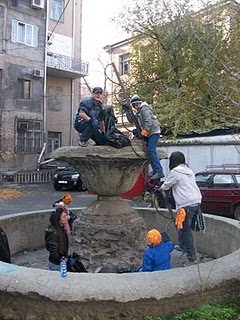
I’m realizing now that I completely forgot to answer the question that I began this whole reflection with: what makes people want to volunteer? This was an important question for me because one of my main goals in Armenia was to convince my students that volunteering could be a thrilling experience. On December 5, fifteen of my students joined me at the cascade for International Volunteer Day. I gave them all trash bags and gloves and we spent the next 5 hours running around Yerevan picking up trash. I was really nervous that I was going to have to stop a lot and organize some fun game so they wouldn’t get tired, or bored, or upset or disappointed… but I didn’t. They had so much fun. They were running from courtyard to courtyard, climbing up trees to pick out trash, laughing and skipping all day (I know it sounds cheesy but its true!) When I finally made them take a break they were restless and wanted to get back out there. At the end of the day, they were all so happy and cheerful. One student even asked me if he could take some trash-bags with him on his way home to pick up trash. One asked if we could do this every day. I was so thrilled. It was clear to me that they had easily picked up the volunteering bug. It’s not really a bug or a foreign, “Western” concept. It’s the simple idea of doing something good for people and the world we live it. Though it was truly difficult to leave Armenia, and I honestly can’t wait to get back, I left with a smile on my face knowing that I’d helped a few people in Armenia realize what a joy it is to do something for someone else, whether it be picking up their trash, singing them a song, or just flashing them a smile.
This post originally appeared on Sima's own blog, http://simacunningham.blogspot.com/, and is reproduced here with her permission and encouragement.
Labels: Armenia, AVC, Birthright Armenia, Manana Youth Center, music, Naregatsi, Sima Cunningham, volunteering, Warm Hearth
posted by Armenian Volunteer Corps @ 6:20 PM
0 comments


