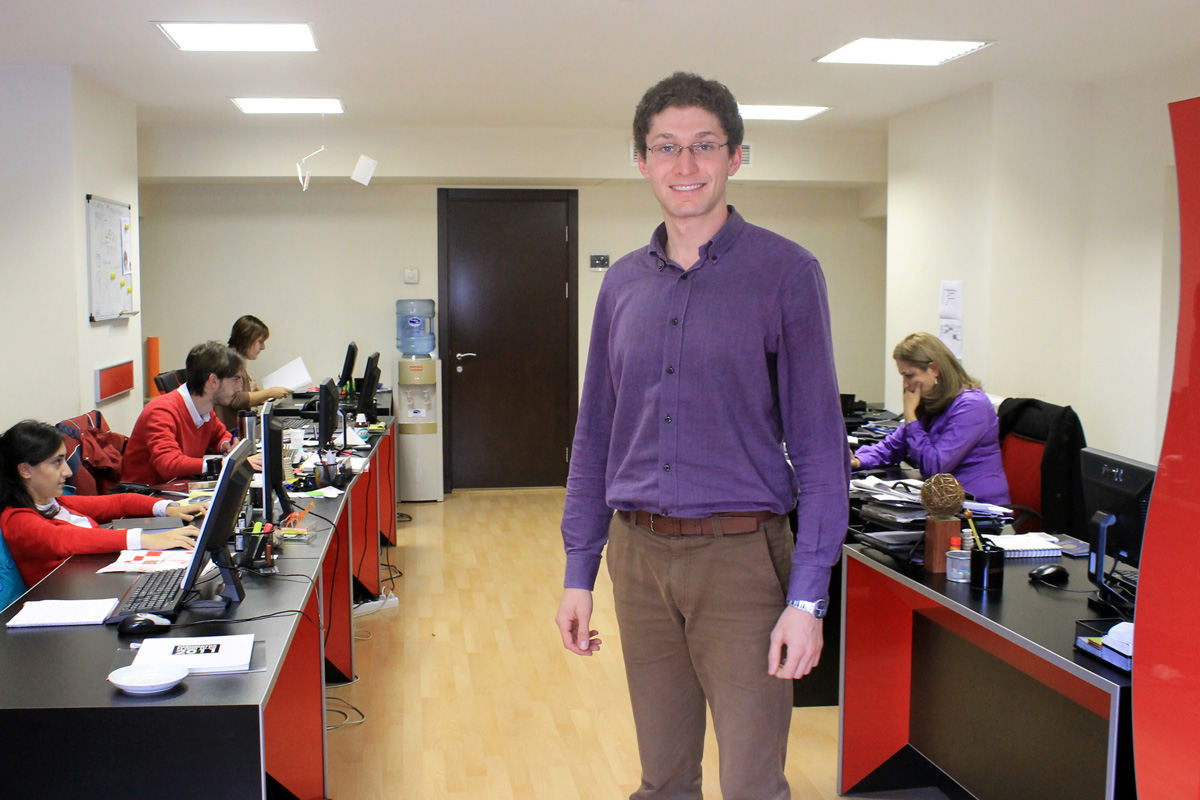
Rebecca Kandilian
USA (Alumnus, 2010)
To celebrate and shed light on the state of the world’s biodiversity, the United Nations has declared 2010 as the International Year of Biodiversity. Furthermore, Conservation International has named Armenia and the Caucuses at large as one of the top 25 biodiversity hotspots in the world. Not a title to be proud of as it means that although it harbors a significant amount of biodiversity, 70 % of it has been destroyed. What is more, prior to this summer, I did not have a slight idea of this rather concerning reality about Armenia’s natural world. But, I went, I saw, I felt and feel compelled to enlighten.
As a biology student engrossed in my studies at the
University of Southern California, I worked for many of its educational outreach programs. Fully devoted to bringing the local youngsters in touch with the beauty of nature while stressing the importance of its protection. A mere act of reciprocity for the sheer beauty, tranquility and the resources that mother nature provides. It is fair to say that I may have never thought about volunteering in Armenia if it were not for two organizations: Birthright Armenia and
Armenian Volunteer Corps (AVC).
Birthright Armenia is a non-profit organization with the mission to bring the Diasporan Youth to volunteer in Armenia. AVC, on the other hand, upon careful consideration of the volunteer’s educational and extracurricular experiences, places him/her at an appropriate site. While Birthright Armenia sparked the thought to volunteer, AVC acted as the catalyst to solidify and finalize my decision. (For more information on Birthright Armenia and AVC please visit www.BirthrightArmenia.org and www.ArmenianVolunteer.org respectively)
Thus, only a few days after my graduation, I accompanied the AVC director to my volunteer site in Yerevan: The
Foundation for the Preservation of Wildlife and Cultural Assets (FPWC) also known as
SunChild. FPWC is a non-governmental organization which, through many educational projects such including its eco-clubs in all regions of Armenia, aims to bring about a new generation of Armenians who will protect and serve as the stewards of Armenia’s natural world and biodiversity. Although I worked on many different projects, my primary focus became the green bus tour which entailed going to and spending a week in three different regions of Armenia (Tavush, Lori and Syunik). There, with the cooperation of the local municipality, we implemented many educational activities which included showing and discussing environmentally relevant films at local schools and kindergartens, organizing forums, and measuring the water quality of the local rivers with high school students.
As I write my impressions of each region, primarily in the light of their unique environmental issues, I will inevitably relive the sixteen-hour workdays on the bus, the sleepless nights, the heart wrenching realities, and the unforgettable touching moments as we go through Tavush, Lori and Syunik. Be prepared to learn about the good, the bad and the beautiful.

Tavush Region
The first stop on the FPWC’s green bus tour was the region of Tavush and specifically the small town of Ijevan. Ijevan’s breathtaking natural beauty had floored me and so had its people, specially the youngsters. Despite the fact that I was quite far from home, and traveling with a group of locals I had just met at my volunteer site, the children made me feel rather at home. Magnetized towards us and the bus, they quickly made themselves comfortable in my arms and hands. Eager to learn and listen to what we had to say and the films we were to show. Nevertheless, I soon had my first encounter with Armenia’s education system which pushed me deep into my thoughts. Part of our green bus program entailed showing environmentally relevant short cartoons to youngsters and discussing them. But, we soon learned the difficulty of doing so as the children were surprised and startled when asked to share their thoughts and opinions about the issues being raised in the films shown. Most tried to find a way to agree with whoever was leading the discussion. In parentheses, I do not in anyway blame these children for such behavior as I am certain they would not object to progressive education that emphasizes critical and independent thinking. I could see the potential in their eyes but at the same time how much it has been repressed. With our time up in Ijevan we headed out to Noyemberyan.
On our way there, it was evident that we had come to the right place. Trash everywhere. The one children’s park that we saw had more trash and plastic bags than kids and swings combined. As we went to the surrounding villages, and spoke with the local municipality, the littering problem was the main topic of conversation and concern. Some said a small fee gets the residents’ trash picked up and thrown away while others said the service is provided by the municipality with absolutely no fee. Yet, in both cases, most people insisted on taking their bucket of trash and dumping it into the local river. Some were saddened by this occurrence but most, perhaps having given up, consoled themselves by saying, with a rather wide grin, that the water ends up in a neighboring country anyway so let it be.
But, this is far from being a laughing matter as although it may end up in a neighboring country, it would inevitably have to go through Armenia first. On our last day, on the way to Debetavan, the last Armenian village hugging the Georgian border, I poked out my head out of the bus to see a fitly, brown and sand filled Debet River. What is more, as we sat down with the municipality and the locals of Debetavan, we learned that people cannot use the river water for irrigation because the crops would simply dry. Consequently, most have left the village leaving a few hundred folks behind most of whom work outside of the village to make a living. The disheartening conditions of the school and the kindergarten made me lose sleep for sometime to say the least. Just as difficult was to see a group of elderly gathered with buckets to get water from one source that the entire village shares.
Of course, I know life is not fair, I also know not everyone has the same opportunities in life and that such conditions and even worse exist in other parts of the world. I would be naïve to think otherwise. But, my heart still ached and still does to this day. Would having a clean, crisp water running through Debetavan, partly prevented by not dumping waste into the river, solve all of the problems of the region or the village itself? No, I am not dull enough to suppose that. But, it would at least allow them the opportunity to raise their own crops, perhaps ship and sell. On days such as this, the mission of FPWC and its green bus became even more vital as we, among other things, went to almost every village and town in the region and measured the water quality of the local river with a group of high schoolers stressing the importance of keeping them clean. Most were ashamed when they found the water quality in the worst condition possible. Perhaps shame is a good source of motivation to change.

Lori Region
The town of Allaverdi was our first stop in the Lori region and no sooner than my first night there did I learn a hard lesson about its main environmental issue; the open-pit copper and molybdenum mines. As I tossed and turned trying to sleep in the scorching heat and humidity, I realized that my nose was bleeding. Strange. Never have I had a spontaneous nose bleed in my short 22 years. I quickly ran to the bathroom while unintentionally waking up the landlady who took advantage of the opportunity to tell me a story. “For a high school field trip” she began, “they took us to one of the local copper mines and five minutes into our trip, our noses started to bleed.” She then grabbed my hand with exquisite gentleness and took me out to the balcony. “That” she said “is what we breathe,” pointing to the gases flowing out of the chimney of the copper mine across our apartment. “That copper mine, among other ones, is what makes this region’s air thirty times more toxic than it ought to be. That, is what made your nose bleed.” If it was difficult to sleep a while ago due to the heat, it just became impossible after hearing all of that.
Regardless, thanks to the utter cooperativeness of the municipality and the youngsters, after a couple of successful days in Allaverdi, we were on our way to the nearby town of Akhtala. Despite the nauseating smell of the chemicals produced by its copper mine, I was mesmerized by its Monastery. To think that people had the persistence and talent to build such intricate, and detailed moldings with their bare hands just amazed me. It is truly a perfect specimen of a cultural asset which reflects the character of our ancestors. I do not think words can ever do justice to all that it is. But, what I saw and learned next was sickening.
As we introduced ourself as representatives of the Foundation for the Preservation of Wildlife and Cultural Assets (FPWC), the eyes of the municipality staff and the residents of Akhtala lit up and they began to tell. Lori region is rich in copper-molybdenum deposits which has opened the doors for people to use it to produce copper. Certainly, it would only make sense to make use of natural resources to make something useful for people to use. But, the problem lies in the fact that the waste is not disposed of properly. Specifically, in between the monastery and the copper mine, runs the Akhtala River where part of the waste is dumped into while the rest is left out in the open, instead of being fenced by cement, diffusing all through the town and making its way into the lungs of the locals. I was truly heartbroken when I learned that Akhtala’s Monastery did not qualify as one of UNESCO’s world heritage sites due to the radioactive waste produced by the open-pit copper mine across from it. What a shame.
Unfortunately, the effects of polluting the Akhtala River goes far beyond the monastery sitting a few miles across from it. Specifically, the point where the Debed River and the Akhtala River merge together is a revelatory one. This junction clearly shows clear crisp Debed merging with yellow Akhtala river contaminated by the copper mine, and two together flowing towards the Tavush region. Seeing this, right away, reminded me of our visit to Debedavan—a village hugging the Debed River in the region of Tavush. The residents there had complained that their trees were drying and had pointed to the Lori region as the primary source of the problem in addition to the trash dumped by their own residents. They were right. Those folks, all 700 inhabitants of the village, now share the one source of clean water available for the entire village thanks to the carelessness of another region’s copper mines. When mother nature give us a gift, do we not have the moral responsibility to not use that gift to harm our natural world? It all became even more real when we went to the local kindergarten to do our presentation. Besides the suffocating smell of chemicals present in the classroom, the dark under eye circles on the pale faces of the children explained it all. All 30 of them had them. “It is from the polluted water, and air,” explained the staff.
After a melancholic day in Akhtala, we headed out to Teghut and along the way were confronted with massive amount of logs. Deforestation at its best. Teghut is also now a candidate for a copper mine and its residents were split in their opinion. Some supported it saying that it will open jobs as 3,000 jobs had been promised. Others realized that the adverse health consequences far outweighed the job opportunities. I am quite certain that all of the money in the world would not convince me to see any kid in the conditions of the kids of Akhtala.
Syunik Region
After a rather scenic, breezy, and an overcast 10-hour ride through the hills of Syunik, the very southern tip of Armenia, we entered Kapan. Hardly had our bus rounded the corner of the road leading to the municipality building than we saw a group of youngsters gathered and taking part in what looked like a summer day camp. With a chalk in hand, they were diligently writing the name of the local gold mining company all over the streets: the sponsors of the day camp. Mining companies reaching out to the community, a reoccurring theme in the region of Syunik as we learned when we ventured out to Kajaran. Not even for a second did any of the community outreach programs make me overlook their company’s adverse effects on the environment.
Never one to take much notice of car brands, I was startled by the abundance of new cars and SUVs I saw in Kajaran. It also had the most upgraded municipality building I had seen thus far. Not to mention the newly built science laboratories of the local high school that were in the process of implementing environmental studies courses. All compliments of the copper-molybdenum mine that I quickly eyed while we sat with the mayor and talked about our green bus tour. I soon learned that the majority of the town’s residents worked for the mine and were paid quite well by any and all standards hence the very modern cars. But, despite the rather positive picture painted by the mayor, I could not help but ask “where is the waste going?” Perhaps knowing what I would hear next. The Voghji River. Not surprisingly, this river which runs through Kajaran now leads Armenia as the most polluted river along with Debet.
The general consensus of the citizens and the municipality was the following: they’re there, have always been there, and are at least providing us the financial support to counteract their pollution. Not even slightly convinced. Most certainly not content.
Also not content are the residents of the village of Lernadzor. Located in-between Kajaran and Kapan, Lernadzor has a rather concerning environmental issue. Syunik, specifically the hills around Lernadzor, have for a long time been suspected to be a rich source of radioactive ore such as uranium. Recently in 2008, The Uranium Project was launched by the Armenian-Russian Mining Company whose shares are divided equally between the Armenian Government represented by the Ministry of Energy and Natural Resources and a Russian state-owned nuclear energy company. The Uranium Project entails surveying the hills of Lernadzor and upon finding sufficient amount of uranium, mining it sometime in 2010. Although no actual drilling has been done to this point, there was a tangible fear and horror within the residents of Lernadzor who had the very reasonable concern that exploration work, which will involve some sort of drilling into the hills, will contaminate their water subjecting their health and the health of their children to a tremendous risk. Though the project officials have been reassuring that such catastrophe will not happen, the residents have voiced their decision to block the much important road linking Iran to Armenia should the project proceed and drilling take place.
Before I end, I would like to take a moment and talk about our last day in Kajaran where a group of high schoolers and I did a water quality survey. Based on biotic (I.e. type of living organisms), abiotic factors (e.g. temperature, flow rate, pH, turbidity) and other simple calculations, together, we classified a local river’s level of cleanliness. Unlike the past surveys I had done, we were taken to the very source of a river where no opportunity exists for people to contaminate it. It was the first time that I saw what our rivers ought to look like. Flowing with much energy, cold, and clear in contrast to the dirty, sandy, yellow and lifeless warm river waters that I had seen and been in. The substantial contrast between the two pushed me into a moment of introspection. How many people would purposely make their home dirty or allow others to do so? I do not know of too many. Armenia is the only home we have ever known.
This blogpost first appeared as an article in the Friday, October 15, 2010 issue of the Asbarez. Labels: AVC, Birthright Armenia, conservation, environment, FPWC, recycle, SunChild, volunteer